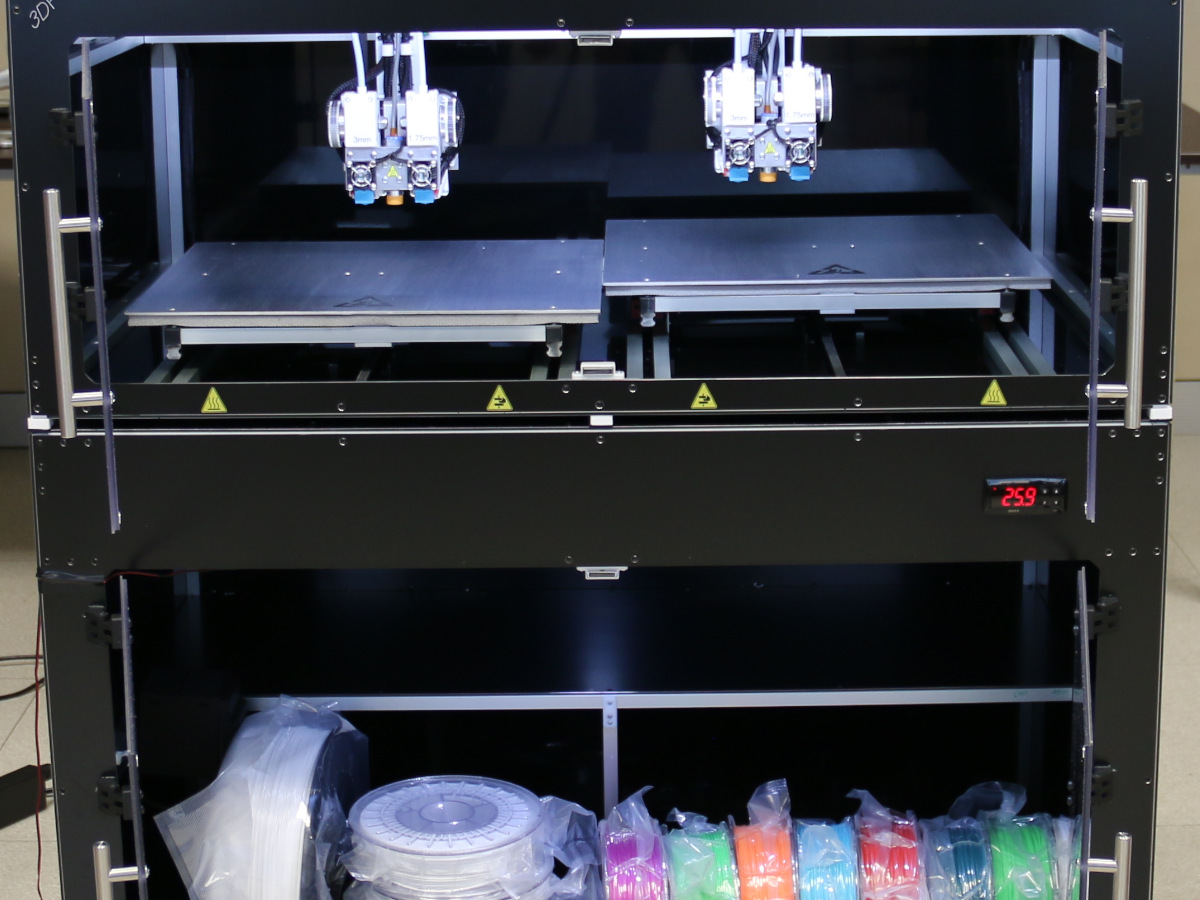
Large-format professional 3D printers are becoming an increasingly attractive solution for companies needing to produce small runs of components, custom parts, and specialized products. Additive manufacturing allows companies to move from digital design to physical objects without having to set up production processes designed for large volumes.
This feature is particularly useful when a company needs to produce from a few units to relatively small batches while maintaining high flexibility. In these cases, large-format 3D printing can offer a combination of customization, speed, and design freedom that makes it easy to adapt to different projects.
Limited-run production has different requirements than mass production. The priority may not be reaching the maximum number of parts per hour, but rather an efficient, repeatable, and economically viable process for small quantities. Therefore, the choice of a professional 3D printer should be made taking all production requirements into account.
What are limited series?
Limited series refers to production runs in which small quantities of a particular component or product are manufactured. These can range from a few units to several dozen, or in quantities that do not justify the implementation of a specifically designed industrial process for large volumes.
This type of production can be found in very different projects:
- Custom components .
- Advanced prototypes.
- Specialized products.
- Spare parts.
- Tools.
- Components for specific projects.
- Products with different configurations.
- Productions intended for niche markets.
3D printing is particularly well-suited to these scenarios because it allows you to modify the design without having to completely change the manufacturing infrastructure.
Why use a large-format 3D printer?
When limited runs include bulky components, large-format 3D printing offers a key advantage: the ability to produce larger parts.
A machine with a large build volume can produce certain components in one piece, reducing the need to divide and assemble them later.
This can simplify the process and reduce some operations.
In other cases, it may be more efficient to divide the model into modules. This strategy allows for the production of different sections and their subsequent assembly, especially when the dimensions exceed the available build volume.
Flexibility compared to conventional methods
One of the biggest advantages of additive manufacturing for small series is flexibility.
Some traditional methods require specialized tools, which are more cost-effective for large-scale production. In small production runs, these initial costs can significantly impact the final price of each component. 3D printing allows you to work directly with a digital model , reducing the need for some preliminary steps.
This facilitates the production of small quantities and allows the product to be modified between batches.
Reduction of initial costs
Producing a limited series does not always justify a large investment in molds, dies, or specialized tools.
Professional 3D printing allows for a reduction in some initial investments since the geometry is generated directly from the digital file.
This could be of particular interest to companies that need to produce:
- Few units of a component.
- Different versions of the same song.
- Customized products.
- Test components.
- Time series.
- Components for special projects.
Profitability should always be analyzed by considering the entire process, but for small quantities, the absence of certain tools can represent a significant advantage.
Personalization of each single piece
One of the most interesting features of 3D printing is the ability to produce different variations of the same piece without having to completely modify the production process.
In a limited series, for example, each component may have small changes to its dimensions, fastening points, or geometry. The CAD file can be modified between production runs, allowing for a series in which each piece meets specific needs.
This possibility is particularly interesting for customized products and applications where different configurations exist.
Leveraging digital design
The connection between CAD design and production is fundamental for the creation of limited series.
Once the model is developed, the company can digitally archive it and use it to produce different batches over time. It’s also possible to create different versions of the same component and store them for future needs.
This digital manufacturing model facilitates the management of components that do not need to be produced continuously.
Materials for limited series
The choice of material for 3D printing must be made based on the intended use of the component.
For some products, conventional thermoplastics can be used, while other components require materials with better mechanical or thermal performance.
Options available in professional applications include:
- PLA .
- ABS.
- PETG.
- Polycarbonate.
- Polyamides.
- Fiber-reinforced materials.
- Composite materials .
The choice must take into account the expected behavior of the component, the required strength level, the finish and the manufacturing conditions.
Reinforced materials for technical components
Fiber-reinforced materials can expand the possibilities of professional 3D printing.
The incorporation of fibers can improve some component properties, such as stiffness, and enable the development of parts suitable for more demanding applications. In limited series, these materials may be attractive for the production of tools, supports, and functional components that require a specific combination of strength and lightness .
However, you need to use a configuration that is compatible with the selected material.
Small batch productivity
Productivity in limited series production must be evaluated differently than in mass production.
When only a few units are needed, the goal may be to reduce the overall project time , including design, preparation, production, and finishing. 3D printing allows you to start directly from the digital model and easily modify it.
Additionally, a large-format printer can leverage its build volume to produce multiple parts in the same run, when its size allows.
Produce multiple components at once
One way to increase efficiency is to exploit the available space within the building’s volume.
When component characteristics allow, multiple parts can be printed in the same session . This strategy can reduce the downtime associated with preparing individual jobs.
However, it is necessary to maintain adequate spatial organization to avoid interference and ensure stable production.
Optimization of production times
Print speed is important, but it’s not the only factor that determines productivity.
A component can be produced quickly, but still require numerous subsequent operations. Therefore, for small production runs, it is advisable to consider the entire process time.
Optimization may include:
Correct orientation + reduced supports + efficient parameters + optimized design + simplified finishing .
The goal is to reduce the time between starting preparation and obtaining a ready-to-use component.
Reduce support structures
Support structures represent an additional cost in terms of materials and time.
When manufacturing large components, excess support can significantly impact process costs and time.
Designing for additive manufacturing allows you to reduce certain overhangs and orient the part to require fewer auxiliary structures.
This can reduce material consumption and also the work required after printing.
Quality and repeatability of the series
Even if production is limited, repeatability remains essential.
When producing ten, twenty or more units of the same component, it is important that the parts maintain similar characteristics.
The stability of the machine, the correct configuration of the parameters and the quality of the material directly influence this aspect.
A standardized process facilitates the production of uniform series and reduces the number of components that need to be repeated.
Quality control
Limited series production must include a quality control phase .
Depending on the application, dimensional checks, visual inspections, or functional tests may be performed. Inspecting the first units can help identify potential anomalies before starting production of the entire series.
The information obtained can be used to adjust the process and improve subsequent units.
Production on demand
Limited series production is closely linked to on-demand production .
A company can store a digital model of a component and produce it only when specifically needed. This system can be particularly useful for spare parts, customized products, and parts that are only needed occasionally.
On-demand manufacturing can help reduce some warehousing costs and avoid producing large quantities ahead of time.
3DPRN and limited series production
Within the large-format professional 3D printing sector , 3DPRN is associated with solutions intended for large-scale additive manufacturing.
For small-scale production, the choice of solution must be based on the characteristics of the parts and the production objectives. It is important to jointly evaluate the build volume, compatible materials, precision, speed, reliability, and operating costs .
The right machine will be the one that allows the production of the necessary quantity of components, while maintaining a balance between quality and productivity.
Advanced prototyping and small production runs
In many projects, the line between prototype and final product is becoming increasingly blurred. A company can start by producing a first unit to validate the design and then produce a limited series using the same technology.
This process allows the same digital workflow to be used throughout the various phases of the project. Once the design is validated, the company can proceed with the production of different units without having to develop a completely different manufacturing process.
Internal tools and components
Limited series production is not limited to customer-facing products.
A company can also use a 3D printer to produce tools, fixtures, supports, and special components in-house . The advantage lies in the ability to develop a customized solution for a specific need and implement it quickly.
If the internal process changes, the instrument can be modified and reproduced using the same digital approach.
Lightweight structures and material savings
Large components can require considerable amounts of material. Using optimized internal structures allows for weight reduction without necessarily creating a completely solid component.
The designer can adapt the density and internal geometry according to the needs of the component.
This strategy can simultaneously reduce:
- Weight .
- Material consumption.
- Print time.
- Production cost.
- Transportation needs.
The chosen structure must, of course, maintain the properties necessary for the application.
Modular production
When the component is too large to be produced in a single operation, modular manufacturing allows it to be divided into several sections.
Each module can be manufactured independently and then assembled. This strategy can facilitate the production of large components and allow for the replacement of a section without having to remanufacture the entire assembly.
It can also be useful to simplify transport and handling.
Benefits for companies with specialized products
Companies working with niche or highly customized products may find additive manufacturing a particularly flexible solution.
The ability to produce small quantities allows us to meet specific demands without the need for large volumes. Furthermore, digital design can be continuously adapted to market needs.
3D printing therefore facilitates more flexible and demand-oriented production.
The role of automation
Even if batches are small, some processes can benefit from automation .
Standardizing print profiles, preparing files, and monitoring specific parameters can reduce manual intervention time. This allows more resources to be dedicated to design, quality control, and planning.
As the number of series and projects increases, automation can become even more important.
When is 3D printing particularly interesting?
Large-scale 3D printing can be particularly cost-effective when several conditions are met:
- Small quantities are needed .
- The pieces are large or complex.
- The degree of customization is high.
- The design changes frequently.
- Development times need to be reduced.
- Creating specific molds is not recommended.
- On-demand production is required.
When these characteristics are present, additive manufacturing can offer an attractive combination of flexibility and efficiency.
The professional large-format 3D printer for small-series production offers companies a flexible alternative for the production of custom components, advanced prototypes, tools, and small series.
The ability to work directly from a digital model allows you to quickly modify designs and adapt each production to specific needs.
Large format also offers the ability to produce bulky components in a single section, when conditions allow, while modular production allows for even larger components. The choice of materials, orientation, print parameters, and internal structures plays a key role in controlling costs and achieving consistent results.
For companies that don’t need large volumes, additive manufacturing can reduce some initial investments and facilitate more flexible on-demand production.
In this context, large-format professional 3D printing represents a particularly interesting technology for limited series, as it allows for the combination of customization, speed, design freedom and production efficiency , bringing digital production closer to the real needs of each project.